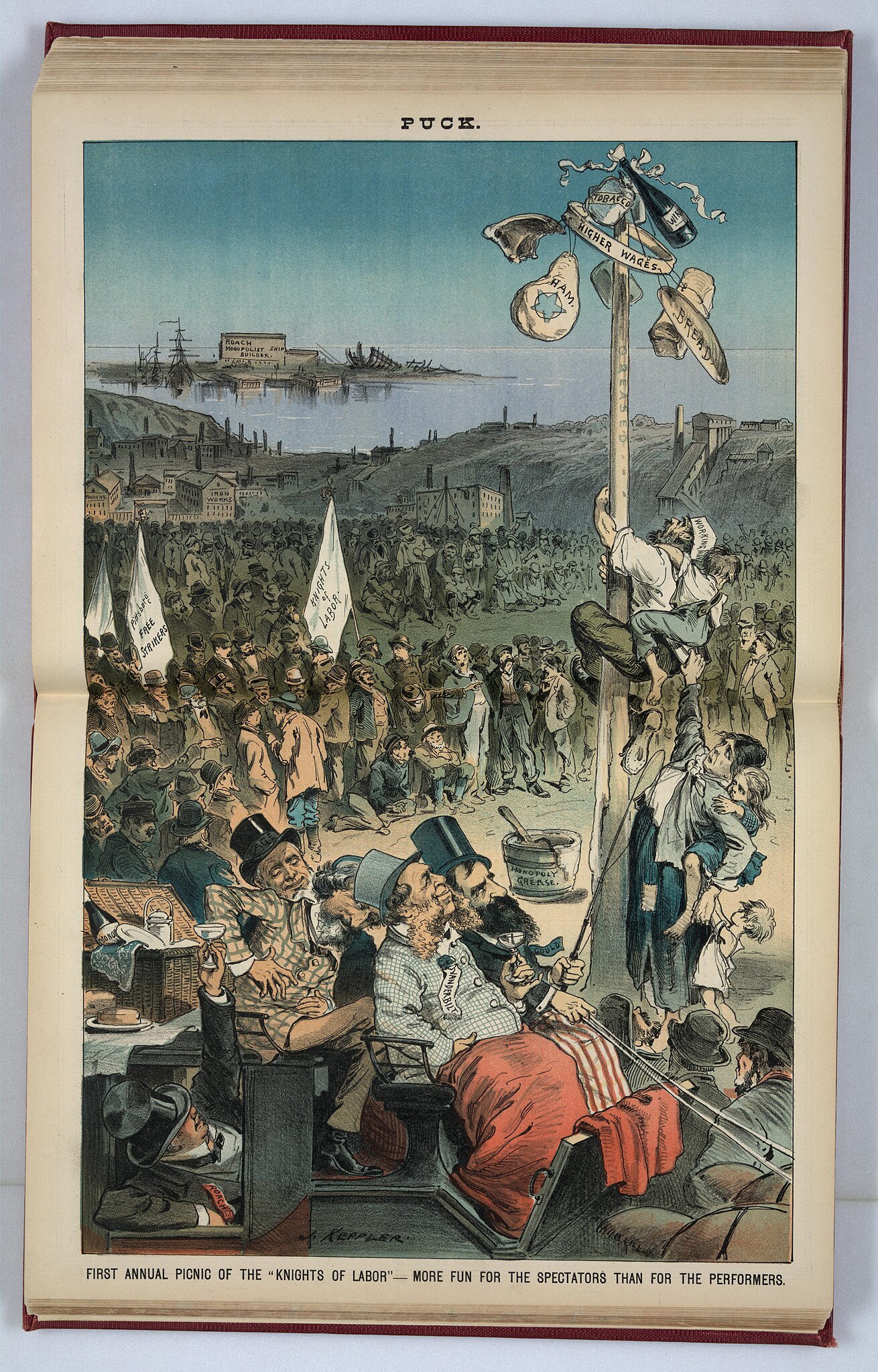
Origins of the Knights of Labor
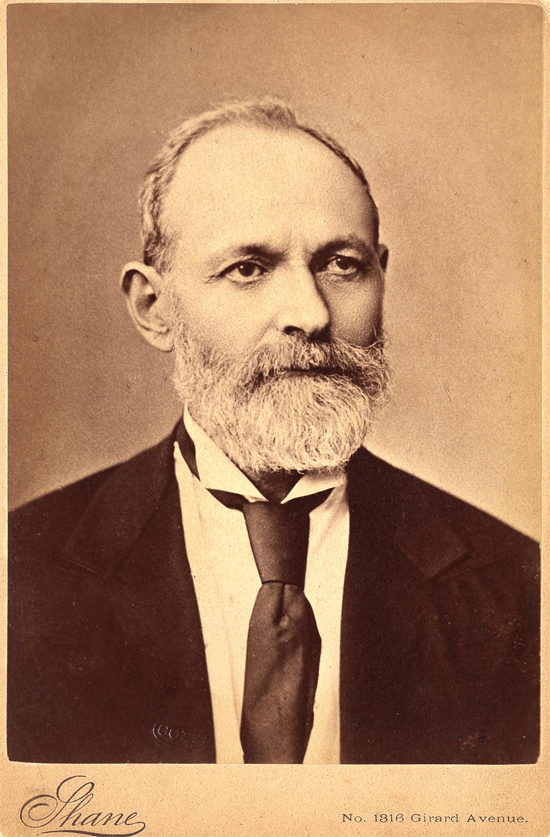
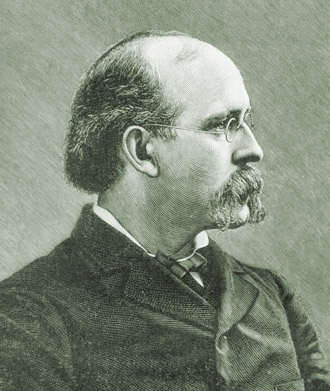
Uriah Stephens founded the Knights of Labor (KOL) on December 28, 1869. The KOL leadership often denounced socialists and anarchists. Yet the union attracted and spawned many radicals. Daniel DeLeon was one of them. He would go on to cofound the IWW and become a leader of the Socialist Labor Party. Several of the anarchist Haymarket martyrs were also KOL members.
One Big Union
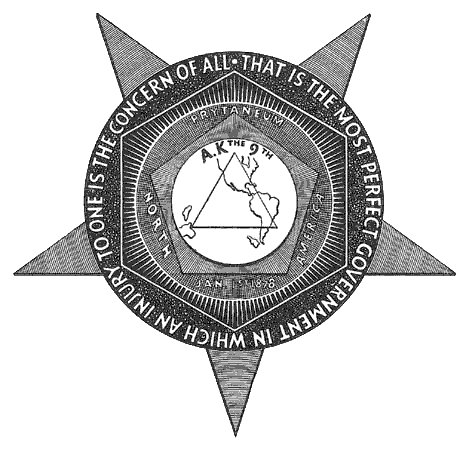
The KOL also denounced strikes. Yet, like its more radical cousin, the IWW, it called for the abolition of the wage system. It also fought to organize all workers into one big union, including women and immigrants. They gave lectures on the evils of wage slavery, monopoly, and over-accumulation of wealth. And, like the IWW, one of the KOL’s slogans was, “An Injury to One is the Concern of All.” The KOL was one of the first labor organizations not only to take on and defeat the Robber Barons. And they were one of the only labor organizations to support the 1877 strike wave known as the Great Upheaval. During that workers’ uprising, the police and military slaughtered over 100 workers across the U.S.
The Knights of Labor was a “brotherhood of toil.” They were open to every laborer, mechanic, and artisan, regardless of country, creed, or color. They were particularly accepting of black workers. At that time, virtually all other unions in the U.S. refused to do so. By 1886, there were over 60,000 African American members of the KOL, with 500 all-black branches, mostly in the South.
Thibodaux Massacre
In 1877, 10,000 Louisiana sugarcane workers went on strike with the KOL. It was the largest strike ever in that industry, and the first to be led by a union. During that strike, the Louisiana Militia, aided by vigilantes, murdered 35-50 unarmed black workers in the Thibodaux Massacre. The massacre ended the strike and any concerted effort to organize black cane workers until the 1940s. And in the wake of that strike, Democrats in the state passed a series of laws that disenfranchised black voters and enforced segregation and Jim Crow.
Anti-Asian Hate
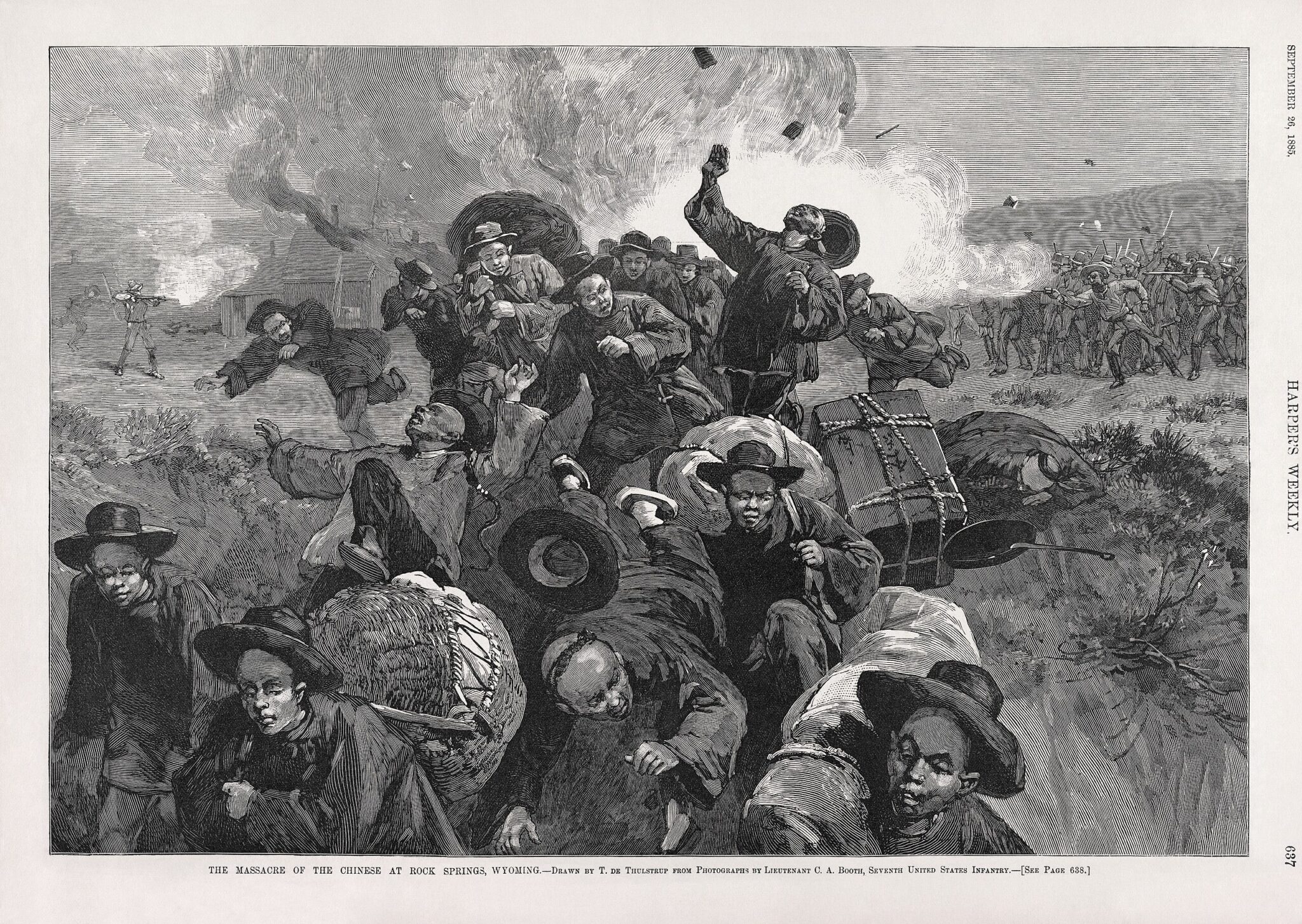
As the KOL grew, so did its xenophobia. They supported the Chinese Exclusion Act, and its members participated in several anti-Chinese pogroms. In 1882, the San Francisco branch of the KOL joined a rally demanding the expulsion of the city’s Chinese population. Several years later, they participated in a pogrom that expelled Chinese residents from Seattle, Washington. In the 1885 Rock Springs Massacre, in Wyoming, a mob of mostly KOL members murdered at least 28 Chinese immigrant laborers. And they drove the survivors out of the state. Also in 1885, KOL members participated in an anti-Chinese pogrom in Tacoma, Washington, in which over 10% of the city’s Chinese population was expelled. You can read more about America’s history of Anti-Asian hate here.
The KOL, like the IWW, often included music in their regular meetings, and encouraged local members to write and perform their work. In 1885, a Knights of Labor songbook was published that included the song, “Hold the Fort,” which was often included in the IWW’s Little Red Songbook. It was the most popular labor song in the U.S. until IWW member Ralph Chaplin’s anthem “Solidarity Forever.”