1800s
Today In Labor History April 8, 1864: The 13th amendment to the U.S. Constitution was ratified, banning chattel slavery. However, it permitted a continuation of wage slavery and the forced labor of convicts without pay.

April 8, 1896: Songwriter Yip Harburg was born on this day. Harburg was known for the social commentaries of his lyrics. HUAC had him blacklisted for his radical politics. Consequently, he couldn’t travel or work in Hollywood for many years. Some of his most famous songs include: It’s Only Paper Moon and Brother Can You Spare a Dime.
1910s
Today In Labor History April 8, 1911: A massive explosion at the Banner coalmine, near Birmingham, Alabama killed 128 convict miners, mostly African-American. The Triangle Shirtwaist fire, occurred just two weeks earlier and elicited massive public attention and support for poor immigrant women. However, the Banner explosion garnered almost no public sympathy. This was probably because of racism and the fact that they were prisoners.

April 8, 1916: The police arrested Emma Goldman for giving a lecture on birth control.
April 8, 1918: President Wilson established the War Labor Board to arbitrate (i.e., quash) labor disputes during WWI.
1930s
Today In Labor History April 8, 1935: Congress approved the WPA (Works Progress Administration). The program created 8.5 million low-paying federal jobs to relieve unemployment during the depression.

April 8, 1935: Oscar Zeta Acosta was born on this day. Acosta was a Chicano lawyer, writer and activist in the Chicano movement of the 1960s and 1970s. He wrote Autobiography of a Brown Buffalo (1972) and Revolt of the Cockroach People (1973). He was good friends with Hunter S. Thompson, who called him “My Samoan Attorney,” in Fear and Loathing in Las Vegas. Acosta disappeared in Mexico in 1974. He is assumed dead.
April 8, 1937: The UAW struck a GM plant in Ontario to win union recognition.
1940s
Today In Labor History April 8, 1943: President Roosevelt froze wages and prices. He also prohibited workers from changing jobs. These moves were ostensibly made to reduce inflation.
April 8, 1943: The Nazis executed Otto and Elise Hampel for making anti-Nazi postcards and leaving them in public places.
1950s
Today In Labor History April 8, 1952: President Harry Truman sent the U.S. Army to take over the nation’s steel mills to avoid a strike. But, three weeks later, the Supreme Court ruled the president’s action to be illegal.

April 8, 1953: The British convicted Jomo Kenyatta for his role in the Mau Mau uprising against British rule. Kenyatta later became Kenya’s first president and first black head of state.
1970s

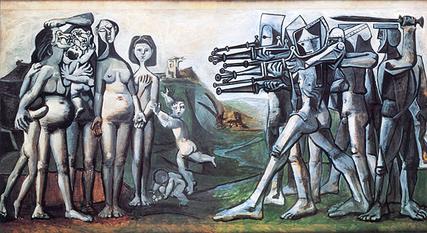
Today In Labor History April 8, 1973: Pablo Picasso died on this day. During the Civil War, Picasso sympathized with the Republican cause, Consequently, they appointed him director of the Prado art museum in 1936. He joined the French Communist Party in 1944, which strained his relations with Andre Breton. He made several political paintings, such as Guernica (1937), Massacre in Korea (1951), and The Dream and Lie of Franco (1937). The feature image for this post is Massacre in Korea.