
Larry Itliong and the Filipino Roots of the United Farm Workers Movement go back to 1906-1934. This was during the first wave of Filipino immigration to the U.S. Modesto “Larry” Itliong was born in the Philippines in 1913, when it was a territory of the U.S. He immigrated to the U.S. mainland in 1929 at the age of 15. Itliong lived much of his life in the Little Manila community of Stockton, California. He had wanted to become a lawyer, but poverty and violent racism prevented him from pursuing the education required. At the time, Filipinos were barred from owning land in the U.S. and from marrying white women under the anti-miscegenation laws. They were also regularly attacked by racist mobs.
Itliong began working in California’s Central Valley, where he joined his first strike in 1930, at the age of 16. Soon after, he began organizing his fellow workers. In 1956, he founded the Filipino Farm Labor Union, in Stockton. He spoke several Filipino languages, as well as Spanish, Cantonese, and Japanese. This was useful in organizing the muti-lingual, multi-cultural farmworkers. In addition to organizing California farmworkers, he also organized cannery and agricultural unions in Washington, Montana, South Dakota. And in Alaska, where he lost three fingers in a cannery accident, earning him the nickname “Seven Fingers.”
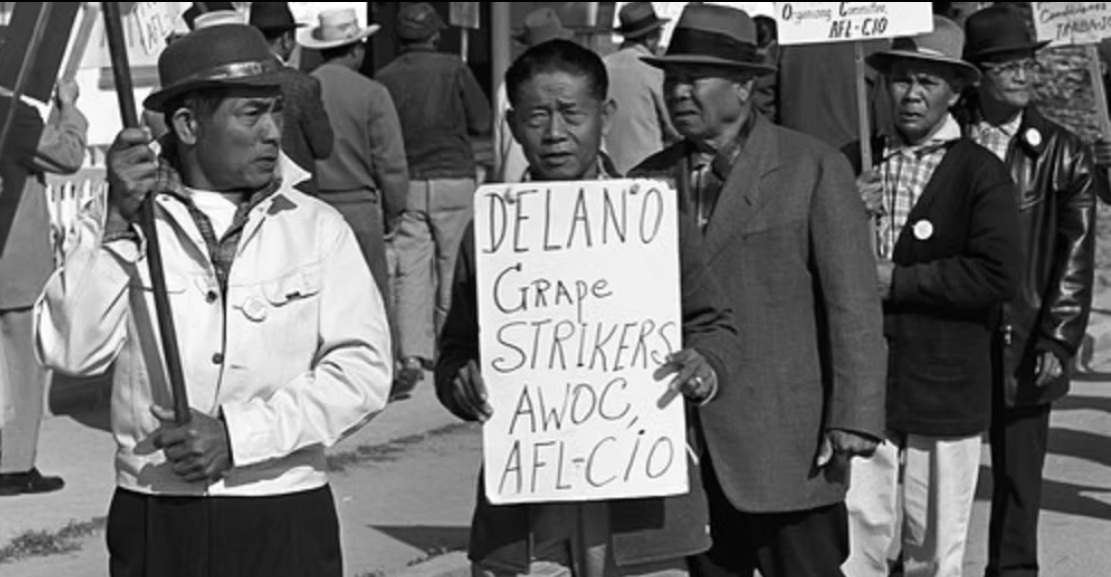
The Delano Grape Strike
On September 7, 1965 Itliong, who now had nearly 3 decades of labor organizing experience, traveled to Delano, California. There he convinced the grape workers at Filipino Hall to vote for a strike. The next day, the Delano Grape Strike began. Over 2,000 Filipino farmworkers walked off the job. They demanded $1.40 an hour, 25 cents a box, and the right to form a union. Itliong led the strike, along with Philip Cera Cruz, Benjamin Gines and Pete Velasco.
Historically, the growers would pit workers of different nationalities against each other. They used Mexican workers, specifically, as scabs to break strikes by the militant Filipino workers. This time, however, Itliong contacted Cesar Chavez and asked him to get the Mexican workers to support the strike. Initially, Chavez didn’t believe his members were ready to go on strike. But when he, and Dolores Huerta, brought the proposal to their 1,000 members, they voted unanimously to join AWOC on the picket line.
The United Farm Workers
The following year, AWOC and NFWA merged to form the UFW, where Itliong served as assistant director under Chavez’s leadership. However, as the nascent union grew, with the charismatic and media-savvy Chavez leading press conferences, fasts and marches, its public face became overwhelmingly Chicano. Consequently, Filipino workers who had started the strike, who had been organizing in the Central Valley since the 1930s, were increasingly marginalized. Leadership often excluded them from decision-making, and their needs as an aging, largely male, immigrant workforce were not always prioritized. In 1971, Itliong resigned from the UFW over these issues.
Some have argued that the ¡Sí Se Puede! slogan, the imagery of la causa (e.g., the UFW black eagle logo), the connection to the broader Chicano movement, all served to create a narrative that was far more tangible and palatable to the mainstream press, and the white public, than one that included Filipino workers, language and culture, a demographic that was much less well known to white Americans. And California K-12 textbooks failed to mention Itliong, or Filipino farmworkers until 2016, fifty years after the strike that began with Filipino workers.